




How to Decide on Which Senior Care is Right For Your Parents
Most families do not research senior care. They research it at 11 p.m. on a Tuesday, from a hospital parking structure on Fair Oaks Ave, after a doctor said the words "she can't go home like this."
That is a terrible moment to learn a new vocabulary. And the vocabulary is genuinely confusing, because four different things get discussed as if they were four points on a single scale, when in fact they are four different products, licensed by three different California state agencies, paid for in three different ways.
This guide sorts them out. I have spent more than twenty years in clinical operations as a registered nurse before founding Lively Assist, and the sorting is almost never about which option is "better." It is about matching a specific set of triggers to the specific level of supervision and licensure those triggers require. Get the match right and you spend the correct amount of money on the correct thing. Get it wrong and you either pay for a level of care your parent does not need or, far more dangerous, you buy a level of care that cannot legally or practically handle what is coming.
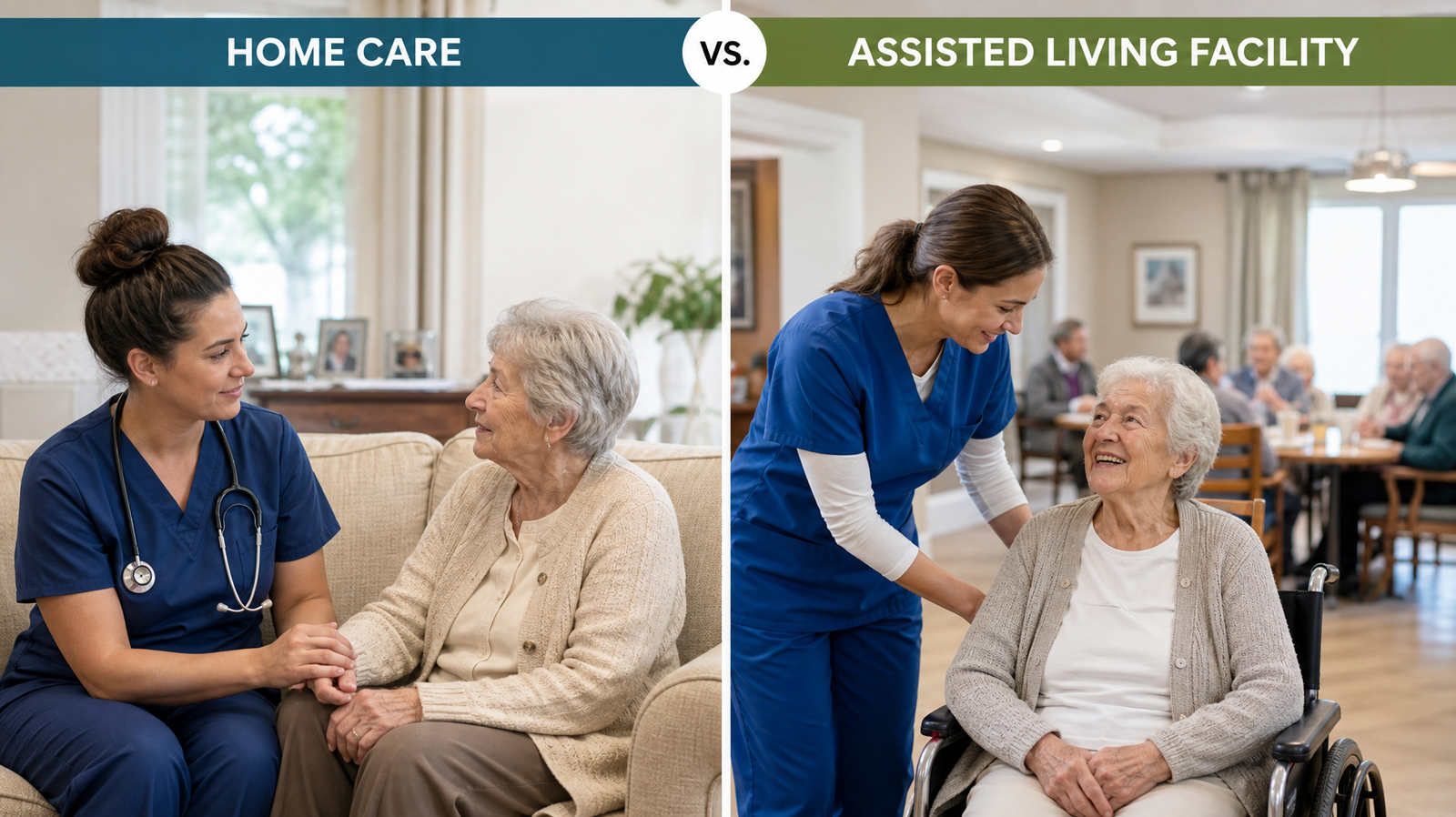
The short version: In-home care supports someone who is safe in their own home with help. Assisted living replaces the home when the home itself has become the problem. Memory care is assisted living with a secured perimeter and dementia-trained staff. Skilled nursing is a medical facility, usually for a short rehabilitation stay after a hospitalization, not a long-term housing choice.
Now the long version, because the short version is where families make expensive mistakes.
In-home care (non-medical)
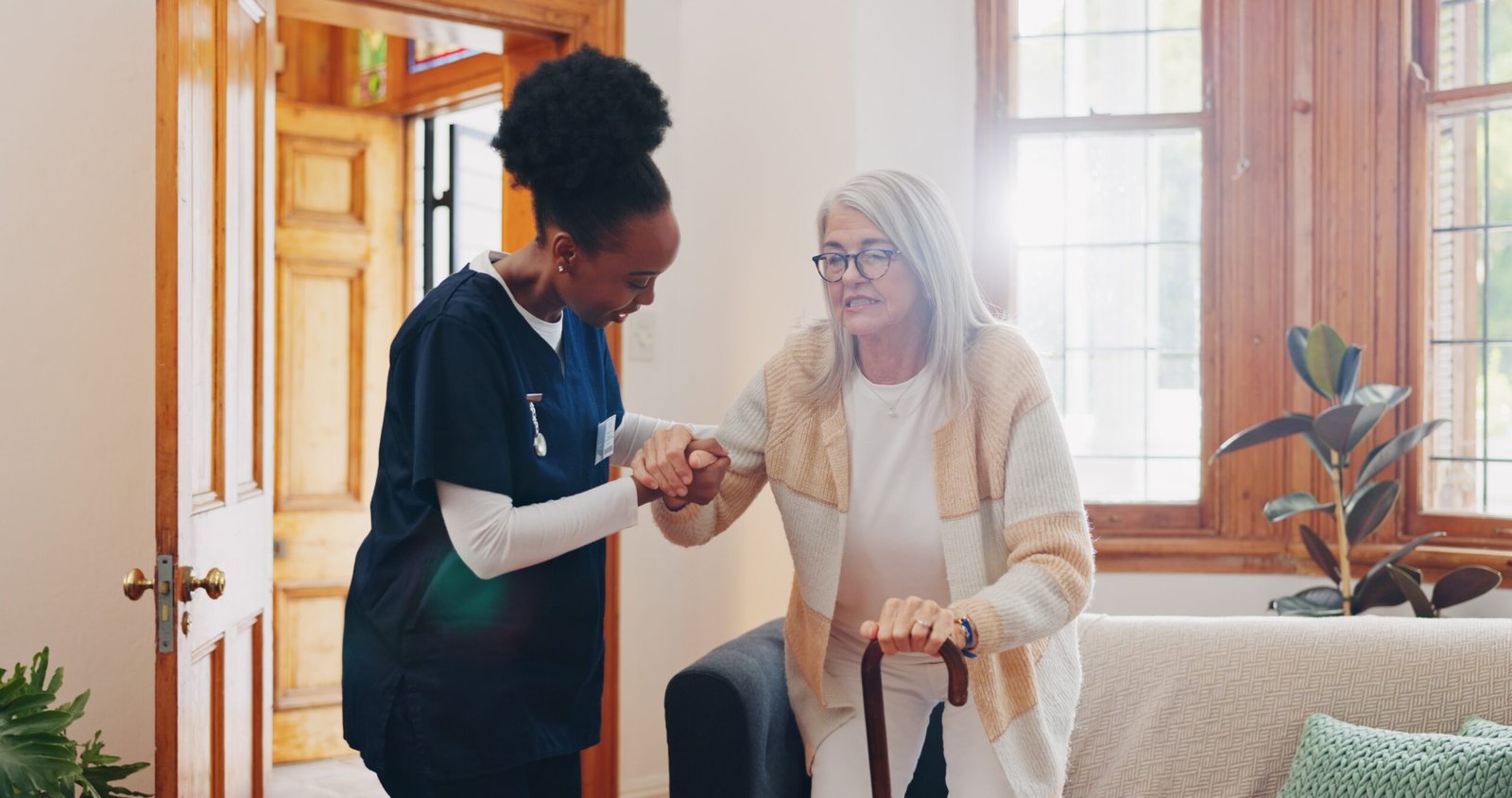
A caregiver comes to your parent's house. They help with bathing, dressing, mobility, meals, medication reminders, laundry, errands, driving to appointments, and companionship. They do not perform medical tasks.
In California, agencies that provide this must hold a Home Care Organization license issued by the California Department of Social Services under the Home Care Services Consumer Protection Act. Individual caregivers must be listed on the state's Home Care Aide Registry, which requires a Department of Justice and FBI background check. If an agency cannot give you its HCO license number, walk away. If someone is offering you care without either credential, you are hiring a household employee, not buying a service, and the tax and liability exposure is yours.
What it does well: preserves the home, preserves routine, scales up and down by the hour, and is one-to-one attention rather than one caregiver shared across a building.
What it cannot do: it cannot be everywhere at once unless you buy 24-hour coverage, and at 24 hours a day the math changes completely.
Assisted living (in California, an RCFE)
What everyone calls "assisted living" is licensed in California as a Residential Care Facility for the Elderly, or RCFE, regulated by the Department of Social Services Community Care Licensing Division under Title 22, Division 6, Chapter 8 of the California Code of Regulations.
Here is the part Los Angeles families miss, and it matters enormously in our market: an RCFE license covers two very different kinds of places.
-
The large community with a lobby, a dining room, an activities calendar, and 60 to 150 residents. This is what people picture.
-
The small residential board-and-care home, typically licensed for six beds, operating out of an ordinary single-family house on an ordinary residential street.
Both are RCFEs. Both are licensed and inspected under the same regulations. Los Angeles County has an unusually dense supply of six-bed board-and-care homes, and they are scattered throughout Glendale, Burbank, Sun Valley, Tujunga, Altadena, and the north Pasadena neighborhoods. They frequently cost less than the big communities, offer a much higher staff-to-resident ratio, and are the right answer for a quiet person who would find a 120-resident building overwhelming. They also vary wildly in quality, which is why the licensing lookup below matters.
What it does well: 24-hour (usually) awake staff presence, meals, medication administration, and a building designed for aging bodies rather than a 1948 Craftsman with a staircase.
What it cannot do: an RCFE is a non-medical setting. Staff are not nurses. Hard regulatory limits govern what conditions a facility may accept or retain, and those limits are why families get the dreaded thirty-day notice.
Memory care
California does not issue a memory care license. There is no such thing. What the industry markets as memory care is specialized dementia care delivered inside an RCFE, governed by Title 22 Section 87705.
A facility that locks exterior doors or perimeter gates to prevent residents from leaving must notify the licensing agency, obtain a specific fire clearance approving the locked egress, and secure a waiver of the resident's ordinary right to leave. Direct-care staff must complete dementia-specific training. A facility that advertises dementia special care takes on additional training obligations under Sections 87706 and 87707.
The practical consequence: "memory care" is a marketing term until you verify it against the license. Ask for the RCFE license number, ask specifically whether the facility is approved for a locked perimeter or delayed-egress doors, and confirm it on the state's licensing site before you tour, not after.
Skilled nursing (SNF)

A skilled nursing facility is a licensed healthcare facility regulated by the California Department of Public Health, with registered nurses on duty around the clock, physician oversight, and rehabilitation therapy on site.
This is where people go after a stroke, a hip fracture, a serious infection, or any hospitalization that leaves them unable to function safely but still improving. It handles IV antibiotics, complex wound care, tube feeding, ventilator weaning, and intensive physical and occupational therapy.
Medicare may cover a skilled nursing stay following a qualifying inpatient hospital stay, for a limited benefit period, and only while the patient continues to require and benefit from daily skilled care. When the therapy stops producing measurable progress, coverage ends. This is the single most misunderstood fact in senior care, and it produces the most brutal financial surprises.
The critical distinction: skilled nursing is usually a stop, not a destination. Roughly speaking, if the plan is "get stronger and go somewhere," it is a SNF stay. If the plan is "this is where mom lives now," you are looking at long-term custodial placement, which Medicare does not pay for at all.
What each option actually costs in Los Angeles in 2026
Cost data in this industry is messy, and any article giving you one confident number is oversimplifying. Different surveys measure different things: base rent versus all-in, studio versus private room, large communities versus small board-and-care homes. Here are honest ranges for the Los Angeles market.
| In-home care | Assisted living (RCFE) | Memory care | Skilled nursing | |
|---|---|---|---|---|
| Typical LA cost | $35–$45+/hour | $5,100–$7,100/month median range; luxury communities $10,000–$15,000+ | Roughly $9,000/month California average | Approx. $11,700/month semi-private; $15,200/month private |
| What that buys | One-to-one attention, only the hours you use | Room, board, meals, 24-hour non-medical staff, medication management | Assisted living plus secured environment and dementia-trained staff | 24-hour licensed nursing and rehab therapy |
| Licensed by | CA Dept. of Social Services (HCO) | CA Dept. of Social Services (RCFE) | CA Dept. of Social Services (RCFE) | CA Dept. of Public Health |
| Medicare pays? | No | No | No | Yes, short-term after a qualifying hospital stay, with limits |
| Best for | Someone safe at home with support | Someone the home no longer fits | Dementia with exit-seeking or unsafe behavior | Post-hospital recovery requiring skilled care |
Sources for the ranges above include the CareScout Cost of Care Survey, A Place for Mom's 2026 long-term care cost report, and published Los Angeles County market data. Small six-bed board-and-care homes in the San Gabriel and San Fernando Valleys frequently price below the large-community figures shown here.
The crossover point families should actually calculate
Here is the arithmetic that decides most of these cases.
At roughly $40 an hour, in-home care in Los Angeles costs about:
- 20 hours a week: approximately $3,500/month
- 40 hours a week: approximately $6,900/month
- 24 hours a day, every day: north of $25,000/month
Compare that to an assisted living median in the $6,300 to $7,100 range and the pattern is obvious. Below roughly 30 to 35 hours a week, home care is the more economical choice and the better quality of life. Above that, and especially at around-the-clock coverage, a facility is dramatically cheaper for the same hours of supervision.
That is the honest answer, and I give it to families even when it costs us the client. Where the arithmetic breaks down is that the comparison assumes those hours are equivalent, and they are not. Twenty-four-hour home care buys one caregiver devoted entirely to your parent, in their own home, with their own things, on their own schedule. A facility buys a shared caregiver in a shared building. Some families will pay the difference for that and should. Most cannot, and shouldn't pretend otherwise.